An excerpt from In the Arena: The Promise of Sports for Christian Discipleship
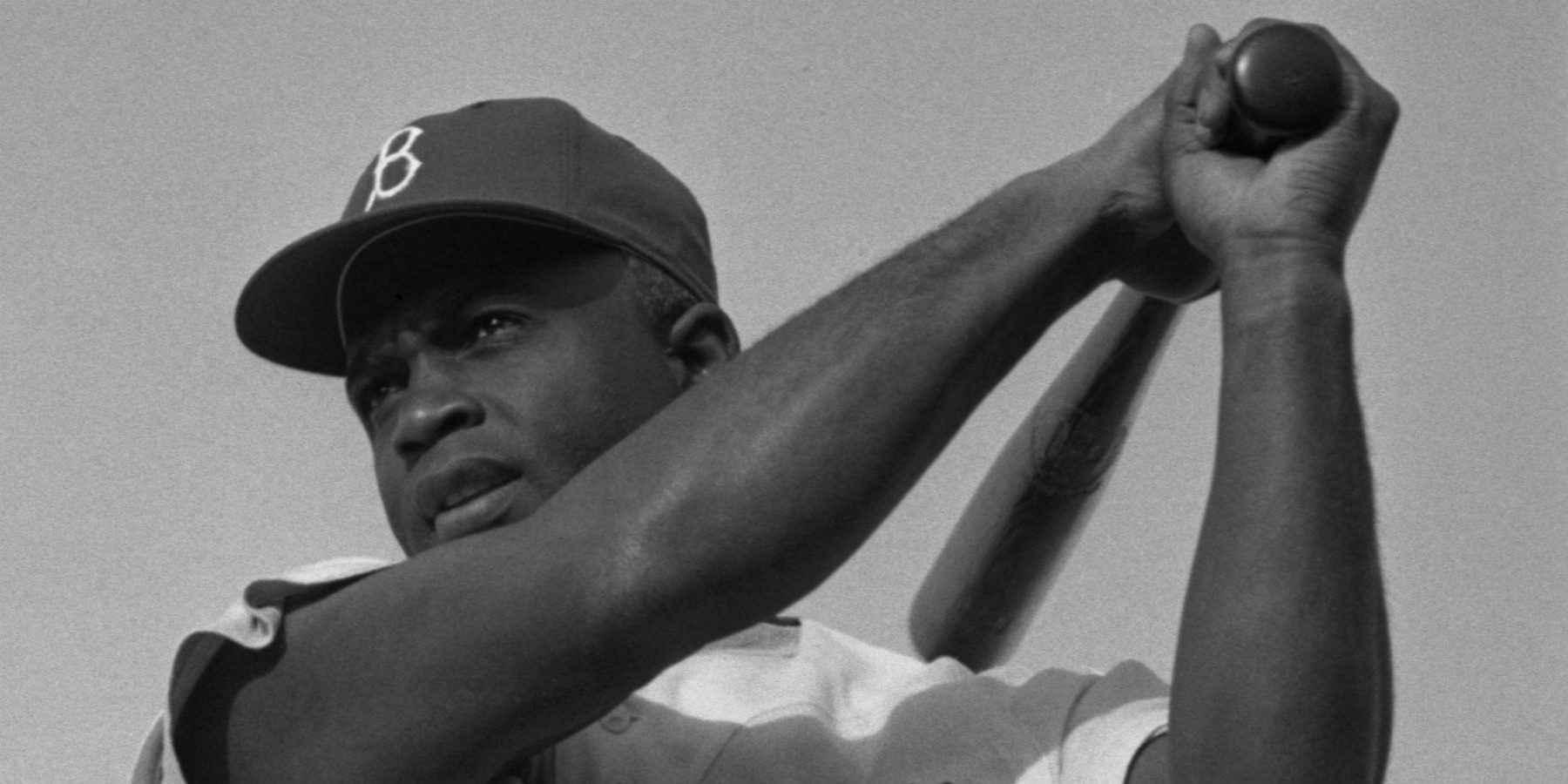
On April 15, 1947, Jackie Robinson, a 28-year-old rookie, courageously ran onto Ebbets Field transforming one of the most sacred spaces in American culture by becoming the first black player in Major League baseball. Robinson’s number 42 has become sacred in Major League Baseball. On April 15, 1997, it became the only number retired throughout the entire league and it is prominently displayed in every Major League Park.
Jackie Robinson and Branch Rickey, the Brooklyn Dodgers president who signed Robinson, were equally indispensable partners in what Rickey deemed “the great experiment.” Rickey meticulously planned and shaped the master narrative for integrating the national pastime, but it could not have been accomplished without a unique player of great ability, personal courage, and unfathomable self-control. Rickey said of Robinson, “God was with me when I picked Jackie. I don’t think any other man could have done what he did those first two or three years.” It is easy to miss the historical magnitude of that moment in 1947 for the advance of civil rights in America. All of Branch Rickey’s advisers, close associates, family, and friends advised him against the move. He did it anyway. When Rickey petitioned Major League Baseball to allow him to integrate the league, the owners voted unanimously against his request. He did it anyway. Consider that when Rickey signed Robinson to the Brooklyn Dodgers, breaking the color barrier in baseball, it was a year before President Truman ordered the US military desegregated, seven years before the U.S. Supreme Court rendered its decision in Brown vs. Board of Education, eight years before Rosa Parks refused to give up her seat on a Montgomery, Alabama bus, ten years before President Eisenhower used the US military to enable the Little Rock Nine to attend Central High School in Arkansas, sixteen years before Martin Luther King’s “I have a dream” speech, seventeen years before the Civil Rights Act of 1964, and eighteen years before the Voting Rights Act of 1965. In their first meeting, August 28, 1945, Rickey stunned Robinson with the news that he wanted him to play for the Brooklyn Dodgers. He grilled him for hours and made him commit to three years of non-retaliation. Rickey read to him from Giovanni Papini’s book Life of Christ and pointed him to the biblical account of Jesus’ Sermon on the Mount. Rickey told Robinson, “We can’t fight our way through this Robinson. We’ve got no army. There’s virtually nobody on our side. No owners. No umpires. Very few newspapermen. And I’m afraid many fans will be hostile. We’ll be in a tough position. We can win only if we convince the world that I’m doing this because you are a great ball player and a fine gentleman.”
Rickey believed that the right player who was also the right person—full of moral courage and willing to commit to non-retaliation for three years—could end what he called an “odious injustice.”
There is a sense in which Rickey and Robinson laid out an incipient strategy that would be later utilized by Martin Luther King Jr. in the larger Civil Rights Movement. Hank Aaron explains the symbolic power of Robinson in a Brooklyn Dodgers uniform when he writes that his father always set him straight when he talked about becoming a pilot or a baseball player by saying, “Ain’t no colored pilots” and “Ain’t no colored ballplayers” but after they sat at Hartwell Field and saw Robinson play an exhibition game in a Dodgers uniform, he never said it again.
There is nobody on our side—Let’s do it