
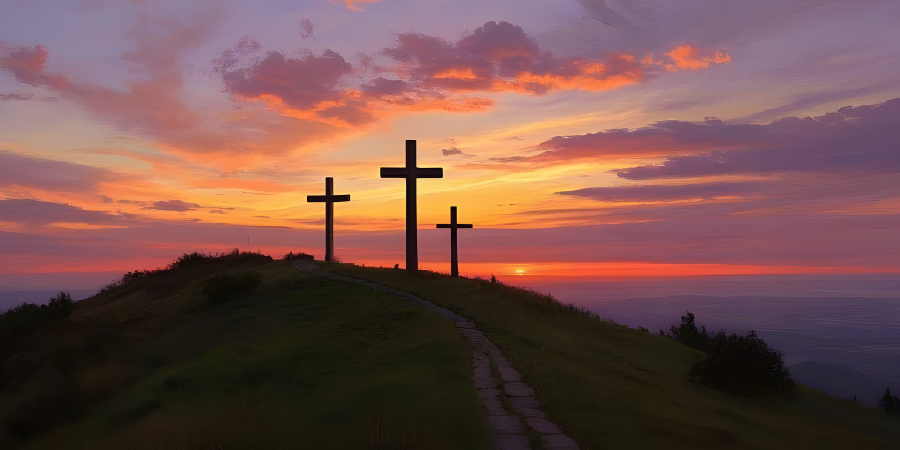
Five days. That is all the distance between the waving palms and the cross. Five days between the crowd crying “Hosanna!” and that same city shouting, “Crucify him!” Five days between what looked like a coronation and what was an execution. The crowds were right about one thing: Jesus was a King. They were catastrophically wrong about what his Kingdom looked like.
Now it is Friday. The cheering is gone. Jesus has been arrested, tried, flogged, and nailed between two criminals outside the city walls. The disciples have scattered. Two of them, walking toward Emmaus after the crucifixion, put the feeling into words: “We had hoped that he was the one to redeem Israel.” Past tense. Had hoped.
John’s Gospel will not let you read the crucifixion account that way.
The Cross Is the Coronation
Every detail in John 19:16–30 is chosen deliberately. The title above his head, the soldiers gambling at his feet, the grieving mother, the hyssop branch, the final word — each one is a theological argument. What looks like chaos is not. What looks like the end is the appointed goal toward which all of history had been pointing.
Pilate posted the charge in three languages — Aramaic, Latin, and Greek — so that every educated person passing the cross that Passover weekend could read it: “Jesus of Nazareth, the King of the Jews.” The chief priests demanded he change it. Pilate refused. He meant it as a taunt. God used his stubbornness to post a proclamation the whole world could read. The cross is not the price Jesus paid before he could reign. The cross is his coronation.
“The Crucified One is the true King, the kingliest King of all, because it was He who is stretched on the cross. He turns an obscene instrument of torture into a throne of glory and reigns from the tree.”
— F. F. Bruce (The Gospel of John: Introduction, Exposition and Notes, John 19:16b–25a, p 366).
No Detail Is Accidental
Then the soldiers gamble for his clothing, and John stops the narrative to quote Psalm 22:18, written by David a thousand years before the crucifixion. These four soldiers had no knowledge of the Hebrew Scriptures. They had no intention of fulfilling prophecy. They were motivated entirely by greed. And they fulfilled a prophetic psalm to the specific detail without knowing it. The death of Jesus was not an accident. It was a plan announced centuries before it happened, executed with a precision only the God who inspired Scripture and governed Calvary could produce.
What looked like chaos, cruelty, and gambling soldiers from inside history was the appointed place of redemption. If God was sovereign over the worst moment in history, the murder of his own Son, then there is no circumstance in your life outside his purposeful reach. He does not simply respond to tragedy. He redeems it (Rom 8:28).
The Savior Who Sees You
Then John shows you something that should stop you completely. In the middle of absorbing the wrath of God for the sins of the world, Jesus looks down and sees his mother. He is not so absorbed in the cosmic that he misses the particular. He sees her devastation. He acts. “Woman, behold your son.” To John: “Behold, your mother.” From that hour, John took her into his own home. The high priest of the new covenant, in the act of offering the once-for-all atoning sacrifice, noticed one grieving woman and provided for her. You are not invisible to this Jesus. He sees you.
The Final Passover Lamb
And then “Jesus, knowing that all was now finished, said to fulfill the Scripture, ‘I thirst.’” They lift a sponge of sour wine to his lips on a hyssop branch. Hyssop, the same plant used on the night of the first Passover to apply the blood of the lamb to the doorpost. John mentions it here deliberately. Jesus is the Passover Lamb. Every sacrifice for fifteen hundred years was pointing forward to this hill.
Not Taken—Given
He bowed his head, not slumped, but deliberately, like a man laying his head down at the end of finished work, and gave up his spirit. The word is active. He handed it over. “No one takes it from me, but I lay it down of my own accord” (John 10:18). He was not overpowered. He completed the mission on his own terms, then He handed his life over as its final act.
Stop Trying to Finish What is Paid in Full
Sadly, some still try to pay for their own sin. You don’t say it out loud, but you live it — carrying false guilt that will not lift, punishing yourself with a low-grade self-accusation that never quite falls silent, spending your spiritual energy trying to prove you are worthy and comparing yourself to others. You are trying to finish what Jesus has already finished. The cross will not allow it. The debt you have been trying to pay was stamped “paid in full!” Every attempt to add to it is not humility. It is unbelief.
“Sinner, there is nothing for God to do. ‘It is finished.’ There is nothing for you to do. ‘It is finished.’ Christ need not bleed. It is finished. You need not weep. ‘It is finished.’ Every stumbling block is rolled out of the road, every gate is opened, the bars of brass are broken, the gates of iron are burst asunder.”
— Charles Haddon Spurgeon, Sermon No. 421 (1861)
The Only Question That Matters
It is finished. Not started. Not almost done. Not waiting on your contribution. Finished. The question the cross puts to you is the only one that matters: are you still trying to finish what Jesus already finished? Or will you trust the one who said, “It is finished! — and meant it?If so, in Christ, when He says, “It is finished!” You can add — for me!

Leave a Reply