
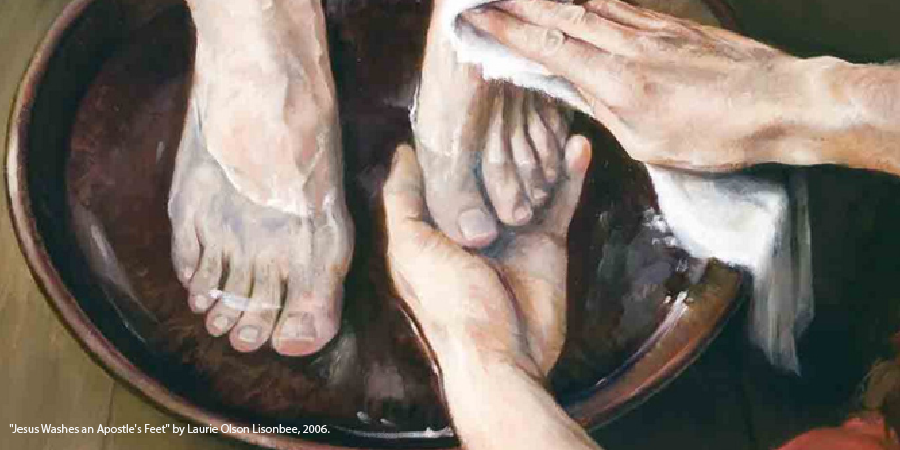
John’s Gospel opens with eternal glory and majesty. In the beginning was the Word, and the Word was with God, and the Word was God. The eternal Son of God, the one through whom all things were made, in whom is life, who is the light of men, took on flesh and dwelt among us. This is John’s opening statement. This is who Jesus is.
Keep that in mind when you get to John 13.
As John’s Gospel moves toward its climax, it slows down. John 12–20 covers a single week. And that week is full of symbols you would never associate with the one described in John 1.
John 12: a donkey.
John 13: a towel.
John 19: a cross.
John 20: a tomb.
The eternal Son of God, the I AM, who performed the miraculous signs of the Kingdom, who turned water to wine, healed the blind, and called a dead man out of his tomb, picks up a towel and washes dirty feet.
What does that mean?
He Knew — and He Loved
The text is relentless: Jesus knew. Jesus knew his hour had come. He knew the betrayal was already in motion. He knew who was going to hand him over. And knowing all of it, he loved his own to the end. The word John uses — telos — is a form of the word Jesus will cry from the cross: It is finished. He loved them completely, totally, to the uttermost. All the way to the cross.
That is the love on display in the upper room. Not a love born of ignorance. Not a love that would evaporate if Jesus knew what these men were really like. He knew. And he knelt.
He Knew His Authority — and He Knelt
Here is where John continues to heighten the wonder. Before describing what Jesus did, he tells you what Jesus knew: the Father had given all things into his hands, and he had come from God and was going back to God. He knew who he was. He knew where he had come from. He knew where he was going.
And so he rose from supper, laid aside his outer garments, tied a towel around his waist, and washed his disciples’ feet.
This service is not weakness. This humility is sovereign power expressed through self-giving love. The one who holds all things in his hands chose to hold a towel and a basin. Don’t miss the logic: he served because he knew who he was, not in spite of it. His security was the ground of his service. He didn’t need to establish his worth. He didn’t need the credit. He didn’t serve to get — he served to give.
That is the pattern of Christ’s kingdom. Authority is exercised through humility. Honor is used sacrificially for others.
He Knew Your Filth — and He Cleansed It
Peter protests. Of course he does. It sounds reverent — Lord, you shall never wash my feet — but it isn’t. Peter is trying to manage Jesus, forcing Him into categories that make sense to him. He won’t let Jesus correct them. Jesus responds without softening: If I do not wash you, you have no share with me.
Peter then attempts to correct Jesus in the other direction: Lord, not my feet only, but also my hands and my head! Peter is attempting to manage Jesus rather than listen to Him. He has thoughts about authority that need to be unlearned to align with Christ’s Kingdom.
You can almost hear it: “Don’t you know who you are?” And Jesus: “Yes. That’s why I’m doing this.”
This act is not merely a call to be a humble servant. It is an enactment of the gospel in living color. Jesus is saying: This is what I came to do. The cleansing of forgiveness, I give you, I alone can give you. There is a reason John places this scene at the threshold of the Passion narrative. The foot-washing points beyond itself to the cross, to justification, to the forgiveness that washes what you could never clean on your own.
He Knew the Betrayer — and He Washed His Feet
Verse 11 is staggering: He knew who was to betray him. Jesus knew Judas. He had traveled with him, taught him, called him. And he knew exactly what Judas was about to do.
And still — he washed his feet.
Let that settle in. Jesus served the man who would sell him for thirty pieces of silver. He showed grace to the one who would hand him over to be crucified. This is not sentimental love. This is concrete, sovereign, knowing, undeserved grace. Proximity to Jesus is not the same as belonging to Jesus. But the gracious honor Jesus showed even to Judas is staggering. Grace serves to give, not to get.
Now You Know
When Jesus finished, he put his garments back on, returned to his place, and asked, “Do you understand what I have done to you?” He doesn’t diminish his authority in the least. You call me Teacher and Lord, and you are right, for so I am. Humility in Christ’s kingdom does not mean pretending you are nothing. It means knowing the one who is everything stoops to serve.
And then he issues the call: If I then, your Lord and Teacher, have washed your feet, you also ought to wash one another’s feet. You cannot be too important to serve. Your Lord is your example. His way of serving is victory, not defeat. It is the way of the resurrection.
In the Kingdom of Christ, honor is not claimed; it is practiced. It is not demanded; it is freely and graciously given.
He knew his hour—and loved to the uttermost.
He knew his authority—and took the towel.
He knew your filth—and cleansed what you never could.
He knew his betrayer—and still washed his feet.
He knew, and he went to the cross and rose from the dead. Now you know. You know what he has done. You know whose feet he has washed. Yours.
You know—so love.
You know—so kneel.
You know—so speak grace.
You know—so serve—even your enemies.
He honored you at the price of his own blood. Go and outdo one another in showing honor (Romans 12:10b).




Leave a Reply